
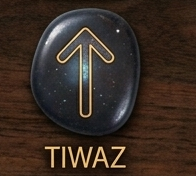
Elder Futhark · Tyr's Aett
Tiwaz
Rune 17 - ᛏ
Upright
A principled, honorable stand will bring a fair and lasting victory.
Tiwaz. A principled, honorable stand will bring a fair and lasting victory. Tyr's rune, first of the final aett. The god who put his hand in the wolf's jaws knowing he would lose it -- justice, sacrifice, and doing the right thing at cost. It is first of Tyr's Aett, the final eight - the aett of the human sphere at full stretch: will, honour, kinship and the self coming into its own. Upright, the stave stands in its clear aspect and can be worked with directly. Its keyword range runs through honor, justice, principled sacrifice, and victory through fair effort.
Merkstave
A cause has been fought unfairly, or resolve has quietly failed.
Tiwaz merkstave. A cause has been fought unfairly, or resolve has quietly failed. Tyr's rune, first of the final aett. It is first of Tyr's Aett, the final eight - the aett of the human sphere at full stretch: will, honour, kinship and the self coming into its own. Fallen merkstave, the stave counsels caution: its force is present but constrained or ill-aspected. A warning to correct course, not a flat denial. In merkstave, read these as strain, blockage, or the caution the rune is raising: injustice, imbalance, a failure of will, and a fight fought unfairly.
About the Elder Futhark
The oldest runic alphabet, used across Germanic Europe from roughly 150 to 800 CE.
No rune names or meanings are directly recorded for the Elder Futhark. The meanings used here are reconstructed from three later medieval sources - the Old English, Norwegian and Icelandic Rune Poems - which give a verse for each rune. 'Merkstave' (a reversed or ill-dignified rune) is a modern reading convention; runes with no natural upside-down form are read only for merkstave when the surrounding runes are adverse.
Full history →Meanings are a guide to a symbolic tradition, offered for reflection and entertainment. They do not predict the future or describe real people or events. See the Terms.